Suggested Price Discount
How this discount calculator helps your pricing decisions
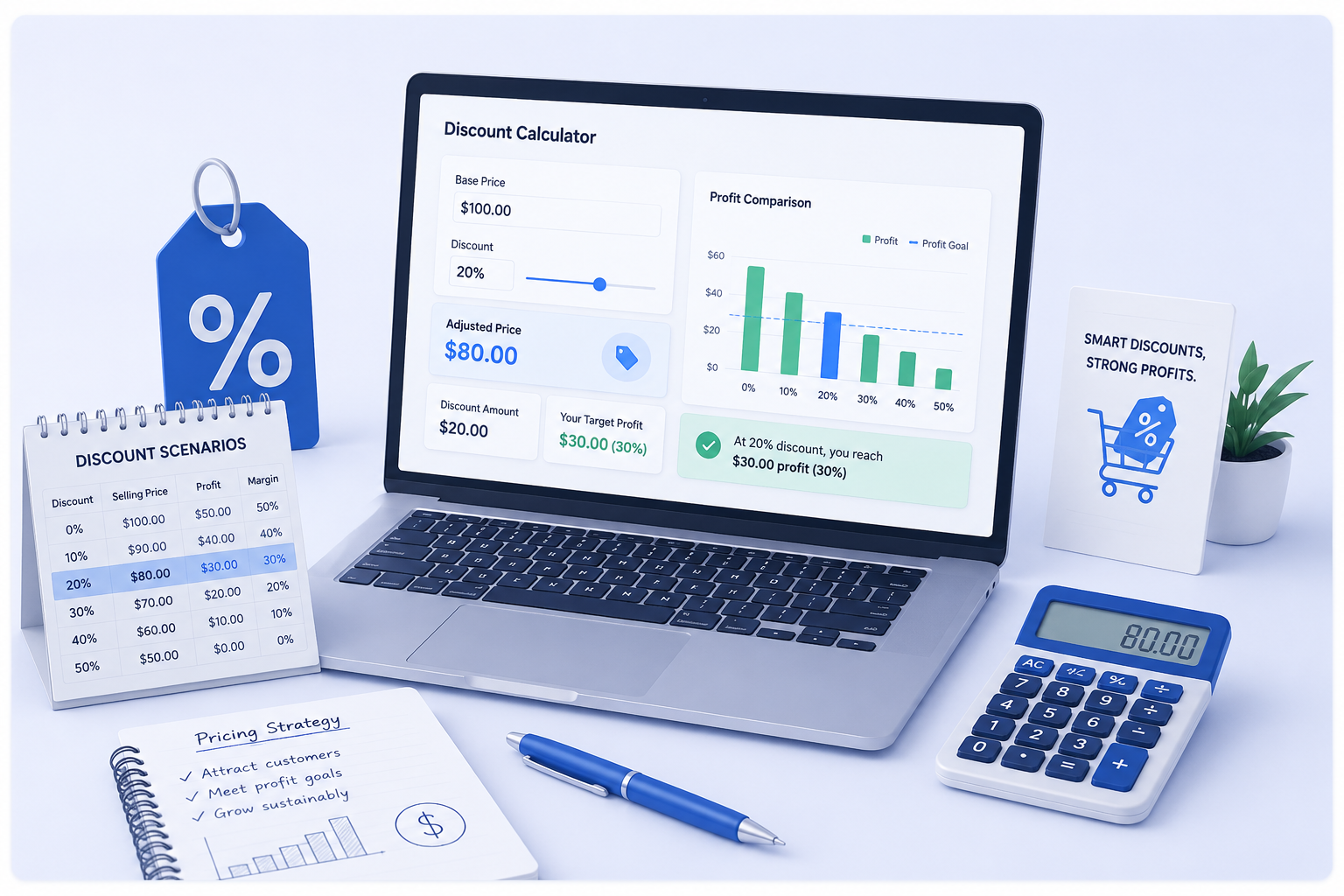
At Clara Studio, this tool helps you test discounts before publishing them in your store. Enter your base price, choose a discount percentage, and compare scenarios while keeping your target profit in mind.
The calculator estimates an adjusted selling price so promotions feel attractive without reducing sustainability for your business.
Use the history table to compare results and find the option that works best for your goals.
Use this discount calculator step by step
Discount inputs
Enter the price you want to receive after the discount and the discount percentage to understand your pricing scenario.
Go to stepSuggested inflated price
Clara estimates the original price you may need to show before applying the discount so the final price stays close to your target.
Go to stepCalculation history
Review previous calculations to compare pricing scenarios and understand how different discounts affect your final numbers.
Go to stepDiscount Inputs
$0.00
Calculation History
| # | Product | Base Price | Discount | Inflated Price | Final Price | Action |
|---|
How discounts affect profitability
Discount pricing can bring attention to a product, but every promotion changes the relationship between selling price, revenue and profitability. A discount calculator helps you estimate pricing after discount before announcing a campaign, so the final price does not accidentally fall below your financial goal.
Promotional pricing works best when it supports a clear sales strategy. You might use a sales promotion to introduce a new product, reactivate previous customers or move seasonal inventory. In each case, the discount strategy should protect the value of your product and avoid training customers to wait only for lower prices.
For any discount plan, the key question is simple: after the discount is applied, does the campaign still support your costs, target revenue and long-term business goals?
When should you use discounts?
Use discounts when they have a clear purpose. For example, a launch discount can help a new product receive its first orders, a limited-time offer can create urgency before a holiday, and a bundle discount can increase the average order when products naturally work together.
Discounts can also help with slow inventory, but they should be planned carefully. If a product has a high variable cost, a large promotion may reduce gross profit too much. Test the final customer price, expected volume and campaign length before publishing the offer.
A useful rule is to connect every discount to a business reason: attract first buyers, recover cash, reward loyal customers or test demand. If the promotion does not support one of those goals, improving the product page, explaining value better or adjusting the base price may be healthier than discounting.
How promotional pricing strategies work
Many businesses do not apply discounts directly from their desired selling price. Instead, they first calculate a higher reference price and then apply a visible discount to create a stronger promotional effect.
This strategy helps customers feel they are receiving a better deal while businesses still stay closer to their original revenue target.
Example scenario
Desired revenue: $100.00
Promotional discount: 30% OFF
Suggested reference price: $142.86
After applying the 30% discount, the final customer payment stays close to the original $100 target.
Businesses often use this type of pricing strategy during launches, seasonal campaigns, inventory clearance, and limited-time promotions.
Why businesses use this strategy
Increase perceived value
Customers react more positively when they see a visible discount opportunity.
Protect target revenue
Businesses can run promotions while staying closer to their financial goals.
Improve campaign performance
Promotions with visible discounts often attract more attention and engagement.